
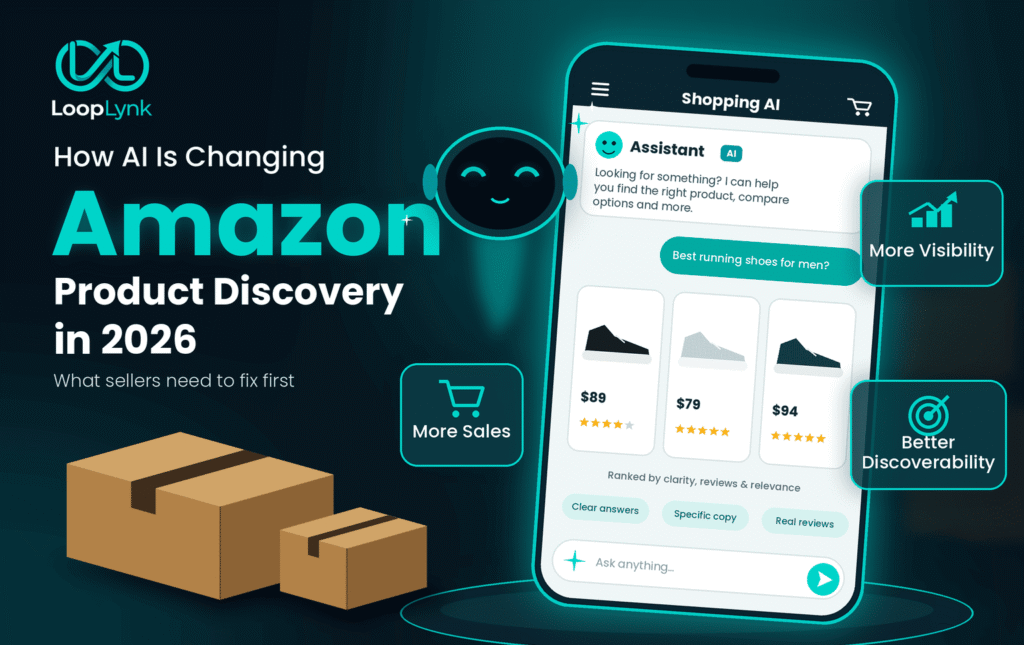
How AI Is Changing Amazon Product Discovery in 2026
Amazon product discovery no longer starts and ends with a search bar. Shoppers still type keywords, of course. However, a fast-growing share now asks an AI assistant what to buy, and that answer decides which products they see.
That shift changes the job of a product listing. Your copy no longer needs to impress only a ranking algorithm. Today it also has to answer questions an assistant can quote.
So here is what changed, and what to fix first.
Key takeaways
- Amazon renamed Rufus to Alexa for Shopping in May 2026, and it now answers questions inside the main search bar.
- Adobe Analytics measured AI-referred traffic to US retail sites up 393% year over year in Q1 2026. It converts better than any other traffic channel.
- AI assistants reward specific, readable copy, and they ignore keyword filler.
- Prime Big Deal Days runs October 6-7, 2026, so this is the week to fix the basics.
What Amazon product discovery means in 2026
Amazon product discovery covers every step between “I need something” and “I added it to my cart.” Two years ago, sellers could describe that journey in three moves. A shopper typed a keyword, scanned the results page, and opened a few listings.
Now three paths run side by side, and each one reads your listing differently. Because of that, you need to satisfy all three.
Path 1: Keyword search
Keyword search still drives most purchases. Amazon’s A10 algorithm and its COSMO intent engine rank products by relevance, click-through rate, and conversion rate. Your title, bullet points, backend search terms, and attributes feed this system.
This path is mature, but it is not frozen. Amazon now blends AI signals into ranking, because the same catalog data trains its assistants.
Path 2: Conversational search inside Amazon
On May 13, 2026, Amazon renamed Rufus to Alexa for Shopping. The assistant moved into the main search bar, and Amazon reports that Rufus helped more than 300 million customers during 2025.
Alexa for Shopping does more than answer questions. For example, it builds personalized shopping guides, compares products, shows up to a year of price history, and can automate deal hunting and reorders.
The purchase signal matters most. Amazon said on its Q3 2025 earnings call that shoppers who used Rufus during a trip were 60% more likely to complete a purchase. In short, chat-based discovery pre-qualifies the buyer before they reach your page.
Path 3: AI assistants outside Amazon
Shoppers also research on ChatGPT, Gemini, and Perplexity before they open the Amazon app. Adobe Analytics found that AI-referred traffic to US retail sites grew 393% year over year in Q1 2026. In July 2026, that traffic was still up 62% year over year.
Those shoppers behave differently. Adobe measured 60% higher conversion rates and 53% more revenue per visit from AI referrals. They also bounce 33% less.
Meanwhile, these assistants read widely. They quote reviews, Q&A threads, blog posts, Reddit threads, and press coverage. Therefore, your product page is only one input in Amazon product discovery. For a deeper walkthrough, see our guide to Amazon listing SEO and conversion.
Why the timing matters this week
Prime Big Deal Days runs October 6-7, 2026. Amazon is promoting AI shopping tools that help members find, track, and score deals during the event.
That creates a specific risk. Deal events drive enormous traffic, and AI assistants now filter part of it. If an assistant cannot find your price, size, or fit details, then you drop out of comparisons you never see.
What AI assistants pull from your listing
Each discovery path reads the same product page, but it leans on different sections. So use this table as a checklist before your next listing update.
| Listing element | What assistants take from it | Quick fix |
|---|---|---|
| Title | Product type, brand, core features | Front-load your main keyword, then add key benefits |
| Bullet points | Answers to common objections | Write each bullet as an answer, with a number or a fact |
| Product description | Context and use cases | Use the full 2,000 characters |
| Q&A section | Direct answers to shopper questions | Seed and answer at least 15 real questions |
| Customer reviews | Sentiment and real-world use cases | Ask buyers to describe how they use the product |
| A+ Content | Brand story and comparisons | Add comparison tables and clear modules |
| Backend attributes | Fit, size, material, category | Complete every field, not just the required ones |
| Off-Amazon pages | Third-party proof | Publish buying guides and specs on your own site |
The pattern is consistent across Amazon product discovery. AI tools reward detail they can quote, and they skip vague claims.
Five fixes, in priority order
- Rewrite bullets as answers. Weak: “18/10 stainless steel.” Strong: “Made from 18/10 stainless steel, so it resists rust and stays dishwasher safe.” Because the second version answers a real question, AI tools can quote it. Our guide to Amazon bullet points shows more examples.
- Fill your Q&A section. AI tools pull direct answers from answered questions. If a competitor has 20 answered questions and you have three, then you lose that comparison.
- Complete every attribute. Amazon uses these fields to match products to questions, filters, and AI summaries. Fix gaps in material, size, fit, and audience.
- Keep titles readable. Keyword stuffing hurts more than it helps now, because AI tools parse meaning instead of counting repeats. So write a title that a person understands on the first read.
- Build proof outside Amazon. AI tools cite external pages. Therefore, publish buying guides, keep your specs in one place, and earn mentions in trade publications.
Where PPC fits when AI filters discovery
Amazon ads still catch shoppers who scroll past an AI summary. However, the mix is shifting, so three adjustments help most. In addition, remember that Amazon product discovery includes sponsored placements as well as organic results.
- Bid on question-style terms. People now type longer, more conversational queries, so add those phrases as exact-match keywords.
- Protect your brand terms. Competitors appear inside AI comparisons, so a defensive campaign keeps you in the click path.
- Watch TACOS, not only ACOS. Advertising cost of sale measures ad efficiency. Total advertising cost of sale measures ads against total revenue, including organic sales. Because AI discovery feeds organic rank, TACOS tells the fuller story.
For the full campaign structure, see our Amazon PPC services page and our breakdown of ACOS vs TACOS.
A 14-day plan before Black Friday
Here is a simple schedule that fits around normal operations. Follow it, and you will see how Amazon product discovery answers change within a month.
Days 1-2: Test what AI knows.
Ask ChatGPT, Gemini, and Alexa for Shopping this question: “best [your product] for [main use case]”. Then note whether you appear and whether the facts are correct.
Days 3-5: Fix the copy.
Rewrite bullets, description, and title. Add specifics such as materials, measurements, and tested limits.
Days 6-8: Seed the Q&A section.
Add ten questions that shoppers already ask in reviews and support tickets. Answer each one in two or three sentences.
Days 9-10: Close attribute gaps.
Complete material, size, fit, and audience fields for every child ASIN.
Days 11-14: Publish one external page.
Write a buying guide on your own site. After that, repeat the assistant test and compare the answers.
Frequently asked questions
Is Rufus gone?
No. Amazon renamed Rufus to Alexa for Shopping in May 2026 and merged in Alexa+ personalization. Because many guides still use the old name, do not worry if you see both.
Does Alexa for Shopping replace Amazon SEO?
No, it works on top of it. Keyword search still drives most purchases. Both systems read the same listing, so stronger copy helps both at once. That is exactly what our Amazon listing optimization service is built to do.
How do I check whether AI can read my listing?
Run three tests. First, ask an assistant for your product by use case. Then ask about one specific specification. Finally, ask for a comparison against a competitor. Wrong or missing answers point to gaps in your copy, because AI systems can only quote what they can read.
How quickly do changes show up?
Indexing changes often appear within weeks. However, conversion improvements usually need 30 to 60 days of clean data before you can trust them.
The bottom line
Amazon product discovery now runs on two engines at once. One matches keywords, and the other answers questions. Sellers who write clear, specific listings feed both.
Start with the copy you already own. Fix the bullets, the description, the Q&A section, and the attributes. After that, test what the assistants say about your product, and correct what they get wrong. Because tools like Alexa for Shopping keep improving, this routine pays off every quarter.
Want a second opinion before the holiday rush? Get a free audit report and we will show you where AI discovery is leaking sales.
Sources: Amazon’s Alexa for Shopping announcement, Prime Big Deal Days 2026 details, and Adobe Analytics AI traffic data via Digital Commerce 360.

