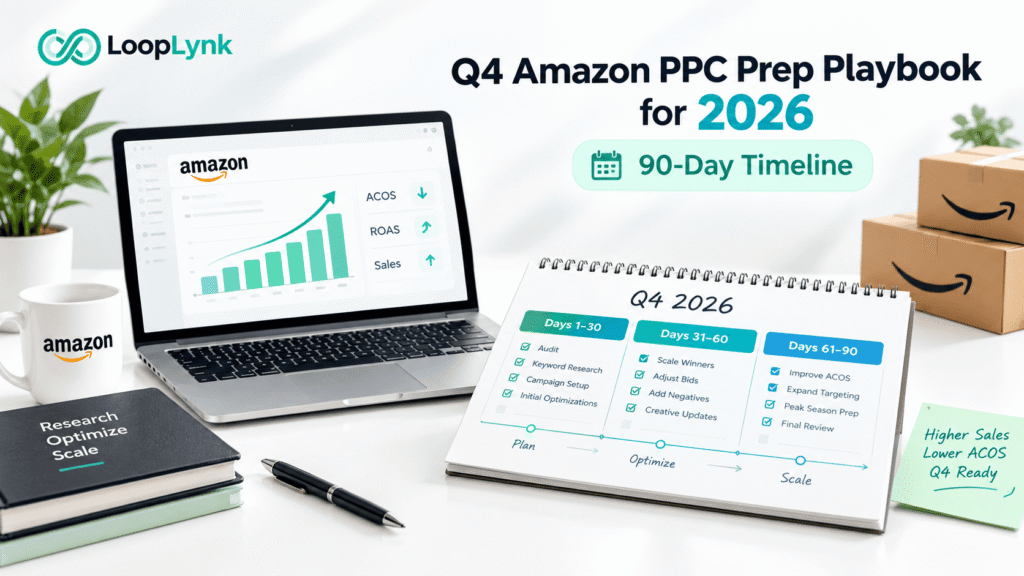
Q4 Amazon PPC Prep Playbook for 2026 (90-Day Timeline)
Q4 2026 Amazon PPC Prep Playbook: The 90-Day Timeline From Prime Big Deal Days to Christmas
It’s September 24, 2026. Prime Big Deal Days opens in 12 days, at 12:01 a.m. PT on October 6. Amazon’s holiday peak fulfillment fees start on October 15. Black Friday and Cyber Monday deal submissions close on October 20.
That’s three separate deadlines inside four weeks — and most sellers will miss all three, then spend November trying to figure out why their ACOS looks worse than it did last year.
Q4 isn’t won in November. It’s won in the last week of September and the first three weeks of October, while the rest of your category is still running July’s bids at July’s budgets. Here is the sequence we use: recalculate the economics first, split the budget by event window, then add campaign structure on top.
Dates below are US marketplace. Confirm your own cutoffs in Seller Central — international dates vary.
Why Q4 2026 Will Not Play Like Q4 2025
Four things changed this year, and each one breaks an assumption that worked last November.
1. Your historical ad data now expires. Sponsored Products reporting rolls off after roughly 95 days; Sponsored Brands and Sponsored Display after about 60. That means last November’s search-term report — the single best predictor of what will convert this November — is no longer in the console. If you didn’t export it, you’re planning Q4 partly blind. Start exporting monthly now; you’ll want December’s file in March.
2. Matching got looser, so negatives matter more. Amazon has pushed Sponsored Products and Sponsored Brands further toward intent- and audience-based matching rather than strict keyword relevance, and broad and phrase match now reach further than they did a year ago. Extra reach is useful in Q4. It’s also more expensive, because clicks you never asked for are billed at the same rate as the ones you did.
3. Your ads are increasingly built from your listing. Sponsored Brands product collections moved to an AI-driven format in January 2026: the 3–10 ASIN requirement came in, custom headlines and lifestyle images went out, and Amazon’s system will now curate products dynamically based on shopper behavior. AI-powered Prompts have been auto-enrolled into campaigns since late March. Practically, your detail page is now your ad creative. If the listing is thin, no bid fixes it.
4. Your break-even ACOS moved on October 15. Holiday peak fulfillment fees run October 15, 2026 through January 14, 2027, at roughly $0.32 per unit above non-peak rates — stacked on the 3.5% fuel and logistics surcharge introduced in April. Every unit you sell in Q4 costs more to fulfill than the same unit in September. Nothing about your ads changed; your margin did.
Meanwhile the clicks themselves are pricier. Average Amazon CPC is running roughly $1.18–$1.25 in 2026, and Q4 event windows typically push it 20–40% above baseline. Holiday demand is still growing — Adobe measured $257.8 billion in US online sales from November 1 to December 31, 2025, up 6.8% year over year, and Prime Day 2026 in June generated $26.4 billion in US online spend. The money is there. The cost of getting in front of it is not what it was.
Step 1: Rebuild Break-Even ACOS Before You Touch a Bid
Before budgets, before structure, do the math on one representative SKU. A worked example on a $34.99 product:
Selling price $34.99, less a 15% referral fee (−$5.25), less FBA fulfillment (−$6.10 in September, or about −$6.64 once the peak and fuel surcharges apply from October 15), less COGS and inbound freight (−$9.50). That leaves roughly $14.14 of contribution before ads in September, and $13.60 from October 15 — a break-even ACOS of about 40.4% that quietly becomes 38.9%.
So peak season costs you roughly 1.5 to 2 points of ACOS headroom per unit on a mid-priced product without you changing a single bid. If you were targeting a 30% ACOS to hold a 20% net margin, that target ceiling has effectively moved.
Do it for your top 20 ASINs, and note that the fee increase hurts cheap products hardest: on a $12 item, the same surcharge eats 4.5 points of margin. Your bid ceiling should not be uniform across the catalog. Q4 is a terrible time to discover you’ve been bidding on your low-margin SKUs as if they were the ones paying the bills.
Step 2: Split the Q4 Budget Into Six Windows
The most common Q4 mistake is treating the quarter as one budget with one target. Different windows do different jobs: October buys data and discovery, Black Friday week buys rank, December buys your cheapest conversions. Split the budget before you spend it.
| Window | Dates | Share of Q4 budget | Job |
| Prime Big Deal Days | Oct 6–7 | 8–10% | Capture event traffic and rebuild best-seller rank heading into the holidays |
| Rest of October | Oct 8–31 | 12% | Harvest search terms; test gift-intent keywords at low risk |
| Pre–Black Friday ramp | Nov 1–25 | 20% | Build impression share before CPCs peak |
| Black Friday week + Cyber Monday | Nov 26–Dec 1 | 25% | Defend top of search on hero terms; wring the two peak days |
| December | Dec 2–24 | 25% | Convert shipping-deadline urgency; long-tail and gifting queries |
| Post-Christmas | Dec 26–31 | 5% | Clearance and returns-adjacent traffic at minimal bids |
Then convert those shares into daily budgets sized on expected CPC, not last month’s spend. Q4 clicks cost 20–40% more, so a daily number that worked in September will cap out by lunchtime in November. Two mechanics to remember: Amazon paces Sponsored Products around an average daily budget over the month, so your daily figure is a guide rather than a hard ceiling; and if you need a genuine stop, use a portfolio budget rule with a fixed end date on the event campaign instead of hoping the cap holds.
One structural note: if you already run the seven-campaign structure from our 2026 blueprint, you do not need to rebuild it for Q4. You need an event layer on top of it.
Step 3: Add an Event Layer | Don’t Re-Architect
Your evergreen structure handles the other 300 days of the year. Q4 needs a temporary layer above it, with its own budget and its own kill date:
- Event campaigns. Duplicate your top 20–30 converting exact-match terms into a dedicated campaign with a higher bid, its own budget, a scheduled start and a scheduled end. You want event performance visible in isolation, not blended into a campaign that also ran in July.
- Keep discovery separate and capped. Your auto and broad campaigns should sit on a fixed low daily budget during event weeks so they cannot eat the money your hero terms need.
- Product targeting on the ASINs your buyers also buy. Gift shoppers bounce between product pages. Build a product-targeting campaign around the three to five ASINs your customers most often buy alongside yours, and bid 10–20% above your keyword average for those placements.
- Sponsored Brands Video. With Sponsored Brands collections no longer accepting custom creative, video is your remaining format for a message you actually control. Have at least one running through November and December.
- Sponsored Display retargeting. Views and engagement audiences, with a 30–90 day lookback. Shoppers who saw you in October are the ones converting in December, and they convert far more cheaply than cold traffic.
- Align ads with promos. Every coupon, Lightning Deal or event deal should have a matching campaign so the boosted conversion rate gets fed traffic instead of organic demand alone.
Step 4: Negative Keywords | Clean Now, Then Every 72 Hours
Every dollar of wasted ad spend in Q4 costs 20–40% more than the same dollar wasted in July, which is why hygiene is worth more in October than at any other point in the year.
1. Pre-emptive block list, live before October 6. Competitor brand terms you can’t win on price, plus used, refurbished, free, cheap, and the accessory or size-mismatch terms your category always bleeds on. If you still have last year’s export, start from the 50 worst search terms.
2. 72-hour harvest after every event. Pull the search term report, negate anything with 10+ clicks and no order, and promote converters into the exact-match campaign. Do this within three days, while the data is still actionable.
3. Twice-weekly reviews in November. Matching widened this year, so once-a-week is no longer enough on auto and broad campaigns during peak traffic.
4. Don’t permanently ban seasonal terms. A gift-intent query that died in June can be your best December term. Pause it, don’t negate it forever.
5. Audit the Prompts tab. Auto-generated prompts pull straight from your listing data. When they’re inaccurate you pay for the click anyway go edit them.
Step 5: Make Advertising Inventory-Aware
The best campaign in the world is worthless pointed at a sold-out ASIN, and overselling into a stockout destroys the organic rank you spent all year building. For Black Friday week and Cyber Monday, inventory has to arrive by October 14 (AWD), October 21 (FBA with minimal shipment splits) or October 28 (FBA with Amazon-optimized splits). Big Deal Days stock was due September 16 — if you missed that, treat October as a normal-traffic month and shift your weight into BFCM instead of paying event prices for stock you can’t support.
Set the rules by SKU now, not on impulse in November:
- Under 45 days of cover at forecast velocity: bid down 25–30%, switch off broad and auto, keep exact-match defense only.
- 45–90 days of cover: hold, but cap daily budget and pause discovery targeting.
- 90+ days with healthy margin: this is the SKU that carries Q4. Scale it.
- Pre-set SKU-level pauses for anything you cannot restock before January, so nothing goes live on December 18 to chase traffic you can’t fulfill.
- Keep replenishing FBA from AWD where you can — the Prime badge is worth more in December than at any other time of year, and losing it mid-November is a self-inflicted wound.
Step 6: Fix What Ads Can’t Fix
- Listing readiness. Amazon weighs listing quality before it shows your ad: weak images, thin bullets and a low review count reduce your impression share even when your bid is competitive. Fix the detail page before you raise the bid.
- Coupons usually beat bid raises. A 10% coupon typically lifts conversion rate more than a 10% bid increase, and it costs you less. Stack the promo with the traffic instead of buying more expensive traffic.
- Mobile first. More than half of Prime Day 2026 purchases happened on mobile. Check how your video and main image read at 375 pixels wide before assuming your desktop layouts will convert.
- Archive everything monthly. With 95-day and 60-day retention windows on ad reports, your Q4 2026 data will be gone by spring unless you save it. Export it in January — it becomes the most valuable planning document you own for Q4 2027.
The Weekly Operating Routine, Now Through December
| When | Focus | What actually happens |
| Sep 25 – Oct 5 | Lock the structure | Freeze campaign architecture, load the event campaign, publish pre-emptive negatives, verify coupons and deals, re-check break-even ACOS |
| Oct 6–7 | Event | Check performance every four hours; push budget toward hero terms; watch budget rules for caps |
| Oct 8–11 | Harvest | 72-hour search-term audit: negate the dead clicks, promote the converters |
| Oct 12–14 | Re-price for peak | Peak fees start Oct 15 — reset bids and ACOS targets against the new margin |
| Oct 15–31 | Rebalance | Shift spend toward converters, watch TACOS, submit BFCM deals before Oct 20 |
| Nov 1–25 | Ramp | Raise bids and budgets on proven terms, add gift keywords, review inventory cover weekly |
| Nov 26 – Dec 1 | Peak | Daily or hourly checks; protect budget around midnight ET and the evening spikes |
| Dec 2–24 | Convert | Match messaging to ship-by-date urgency; shift discovery budget into exact-match defense |
| Dec 26–31 | Close out | Clearance bids, prune negatives, export reports, write the postmortem while it is fresh |
The Numbers to Watch | Not Just ACOS
- TACOS, because it is the only metric that shows what advertising is doing to total sales rather than to attributed sales.
- Percentage of budget capped, because a campaign that hits its cap before 6 p.m. is refusing conversions you already paid to earn.
- Impression share on your top ten terms, because Q4 is a land grab and rank you lose in November takes months to win back.
- Conversion rate against session count, because if traffic is climbing while CVR stays flat, the problem is the listing, not the bid.
- Cost per new-to-brand customer, which needs a different target from repeat buyers and is the number that tells you whether Q4 built an asset or just bought revenue.
- Seven-day attribution alongside one-day, because Q4 shoppers research before they buy, and one-day reporting understates December performance all season.
Five Mistakes That Cost the Most
1. Raising bids on October 15 without recalculating break-even against the new peak fees.
2. Treating Q4 as one budget with one target, instead of six windows with six different jobs.
3. Ignoring listing quality, now that a growing share of ad creative is generated from the listing itself.
4. Cutting budgets in mid-December because ACOS looks high — urgency compresses decision time, and late-December conversions are typically the cheapest of the quarter.
5. Advertising SKUs you cannot restock, and trading your organic rank for one week of orders.
What to Do This Week
1. Export the last 12 months of search-term and ad reports while that data still exists.
2. Recalculate break-even and target ACOS per unit, with peak fees applied, for your top 20 ASINs.
3. Freeze your campaign structure by October 1 and build the event layer on top of it.
4. Turn your Q4 budget into six windows and set daily budgets sized on expected CPC.
5. Publish your pre-emptive negative keyword list before October 6.
6. Confirm your Black Friday and Cyber Monday deal submission — the window closes October 20.
Today is a fine day to start. October 20 is not.